PVC Coated Welded Mesh is becoming a practical choice for fencing, animal enclosures, garden protection, and light industrial separation. Its steel core supplies structural strength, while the PVC layer adds color, smoother handling, and resistance against moisture. Yet coating quality varies sharply between manufacturers.
Recent reports from Grand View Research and Fortune Business Insights place welded wire mesh within a growing global construction and infrastructure market. Their findings point to urban development, agricultural fencing, and renovation projects as important demand drivers. However, these reports usually group PVC-coated products with wider welded-mesh categories. Exact market figures should therefore be read carefully, not copied blindly.
Material testing matters. A dependable manufacturer should document wire diameter, weld strength, coating thickness, salt-spray performance, and dimensional tolerance. Dr. Robert G. Kelly, a recognized corrosion scientist, has emphasized, “Coatings are only as reliable as the surface preparation beneath them.” That principle applies directly here. Clean steel, consistent welding, and controlled PVC adhesion often decide whether mesh remains bright after years outdoors.
This review compares ten global manufacturers through production capacity, certifications, export experience, product customization, and quality-control practices. Samples reveal practical details: clean weld points, even green coating, firm rolls, and edges that do not cut the hand. Some rankings remain imperfect because private companies disclose limited data. That limitation deserves attention. Buyers should verify current specifications, test reports, and regional compliance before placing large orders.
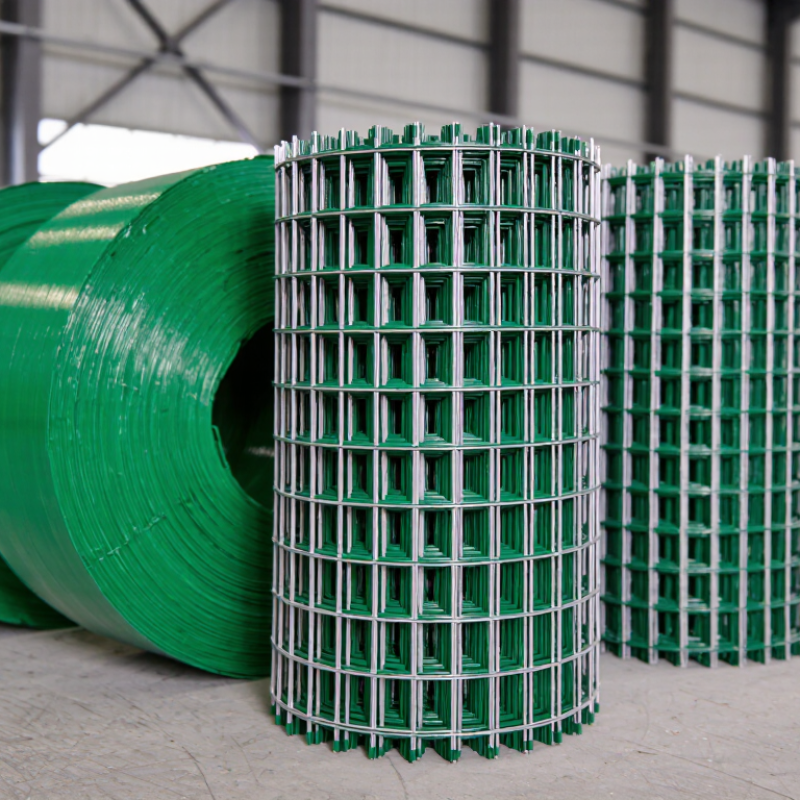
PVC-coated welded mesh is a grid of steel wires joined at each crossing and covered with a polyvinyl chloride layer. The coating adds a smooth, colored surface and helps limit moisture contact with the steel. Some products also have a zinc layer beneath the PVC, but specifications vary. Check the product sheet rather than assuming every mesh has the same protection.
The material suits garden fencing, animal enclosures, storage partitions, and equipment guards. Its square or rectangular openings allow airflow and visibility while creating a physical barrier.
PlasticsEurope’s Plastics – the Fast Facts 2023 report estimates that PVC made up about 12% of global plastics production in 2022. That figure describes the wider plastics market, not mesh demand, but shows PVC’s established role as an industrial material.
In practical use, compare wire diameter, opening size, coating thickness, and the condition of welds. A scratched coating or exposed cut edge can become a weak point, especially in damp or salty environments. PVC is not a substitute for structural engineering; mesh should not carry loads beyond its stated rating. One detail is often overlooked: a thicker coating can improve coverage, yet may hide small defects at the welds. Inspecting a sample helps.
PVC-coated welded mesh begins with steel wire selected for the required strength and opening size. The wire is straightened, cut, and arranged in a grid. At each crossing, resistance welding creates a fixed joint. Consistent spacing matters: uneven openings can complicate installation and weaken the panel’s uniform appearance. The welded mesh is then cleaned and prepared for coating. Depending on the product design, a zinc layer may be applied before the PVC, helping protect the steel if the outer coating is scratched. Preparation is easy to overlook.
PVC is applied by dipping, fluidized-bed coating, or another controlled process suited to the product. Heat helps the coating adhere and cure, forming a continuous layer around the wires and welded intersections. Operators check coating coverage, mesh dimensions, weld integrity, and the finished surface for bare spots, blisters, or sharp projections. A simple visual check catches some defects, but it cannot replace consistent process control. Coating thickness and curing conditions vary by specification, so one setting does not fit every line. Even a good-looking roll deserves scrutiny at its edges and weld points, where coverage can be less uniform.
When evaluating global PVC coated welded mesh manufacturers, compare measurable quality rather than catalogue claims. Check wire diameter, aperture size, coating thickness, and panel dimensions against the stated specifications. Ask how weld strength and coating adhesion are inspected. These details affect whether mesh stays intact during cutting, handling, and outdoor use. Details matter.
Reliable suppliers should provide recent inspection records, clear material specifications, and traceable production batches. Ask about corrosion testing and the conditions used; results can vary with salt concentration and exposure time. A sample panel can reveal uneven coating, sharp edges, or inconsistent welds. It is not a substitute for documented quality checks, but it can expose practical issues. Also assess production capacity, packaging, delivery communication, and the ability to explain tolerances plainly. A polished brochure alone proves little.
Tips: Request a sample and specification sheet before placing an order. Compare coating thickness at several points, not just one. Ask who performs quality checks and how rejected batches are handled. If answers are vague, pause and ask again. That small delay may prevent costly rework.
| Evaluation Criterion | Suggested Weight | Key Data to Compare | Evidence to Request |
|---|---|---|---|
| Product specification clarity | 12% | Mesh opening, wire diameter, panel or roll dimensions, edge finish, and stated tolerances. | Product data sheets and a written specification for each quoted item. Compare like-for-like dimensions. |
| Wire diameter and mesh-opening consistency | 12% | Measured wire diameter and aperture dimensions, including whether measurements refer to the core wire or coated wire. | Inspection records and sample measurements taken with appropriate measuring tools; confirm the agreed tolerances in the purchase specification. |
| Weld integrity | 12% | Weld consistency, joint appearance, and resistance to separation under the agreed test method. | Weld inspection procedures and test results for representative production samples. Agree on the test method and acceptance limits before ordering. |
| Steel substrate and zinc coating | 10% | Steel grade, substrate condition, and the declared zinc-coating class or coating mass where galvanized wire is used. | Material certificates and coating inspection records. ASTM A641/A641M is a specification for zinc-coated carbon steel wire; confirm that the selected grade and product form are covered. |
| PVC coating specification | 12% | Coating material, color, thickness, adhesion, finish, and any stated resistance to outdoor exposure. | Coating data sheets, thickness measurements, and adhesion or weathering test reports. EN 10245-2 addresses organic coatings on steel wire, including PVC coatings; verify the relevant product requirements. |
| Corrosion and weathering performance | 10% | Test method, exposure conditions, inspection criteria, and reported results for the coated mesh system. | Test reports identifying the tested sample and procedure. ISO 9227 specifies salt-spray test methods; salt-spray results should not be treated as a direct prediction of service life. |
| Applicable standards and compliance | 10% | Standards claimed for the mesh type, coating, dimensions, and intended application. | Current declarations, certificates, and supporting test reports. EN 10223-4 covers welded mesh fencing; confirm that its scope matches the product being evaluated. |
| Quality control and traceability | 8% | Inspection frequency, batch identification, nonconformance handling, and traceability from raw material to finished goods. | Quality procedures, sample inspection records, calibration records, and batch-level certificates or reports. |
| Production capacity and delivery planning | 7% | Confirmed order quantity, production schedule, lead time, and ability to maintain the specified product configuration. | A capacity statement tied to the quoted order, a production schedule, and written confirmation of lead time. Compare commitments against the buyer’s required delivery date. |
| Packaging and export readiness | 7% | Roll or panel protection, labeling, packing method, shipping configuration, and export-document support. | Packing specifications, sample labels, and a list of documents available for the destination market and agreed shipping terms. |
Scoring note: The weights are a suggested comparison framework, not an industry standard or a ranking of specific manufacturers. Score each criterion consistently (for example, from 1 to 5) using verified documentation and product samples.
The ten manufacturer profiles should be read as a guide to production strengths, not as a fixed ranking. Capable suppliers typically control wire selection, resistance welding, surface preparation, and PVC coating. Details matter. A clean weld intersection and even coating can help mesh withstand handling and outdoor exposure.
Some manufacturers focus on high-volume rolls for fencing, while others make rigid panels, cages, or custom-sized mesh. Their equipment and quality checks differ. Look for clear information about wire diameter, aperture size, coating thickness, roll dimensions, and tolerances. A useful profile explains how these details are checked, rather than relying on broad claims about durability. Sample inspection can reveal issues that a polished catalogue may not show.
The most reliable producers describe their process and acknowledge its limits. PVC performance depends on the base wire, coating adhesion, installation, and environment; no single product suits every site. Ask whether the supplier tests weld strength and coating consistency, and whether it can provide traceable batch records. Profiles may leave gaps, too. I would treat vague capacity figures or missing test details as reasons to ask more questions, not as proof of poor quality.
Common nominal mesh opening sizes, shown in millimeters with inch equivalents. Actual product availability varies by specification and supplier.
Comparing PVC-coated welded mesh manufacturers begins with the product itself. Check wire diameter, opening size, coating thickness, and weld consistency against the stated specifications. A sample should have an even finish, with no bare spots around welds or sharp, poorly covered cut edges. Small details matter. Ask how the coating is applied and whether adhesion and UV resistance are tested. A specification sheet helps, but it cannot show every flaw in a production run.
Quality comparisons should include documented inspection methods, traceable batch records, and clear tolerances. Where possible, review test results and inspect samples from more than one production batch. Salt-spray and weathering tests can offer useful clues, though results depend on test conditions and do not predict every installation. That distinction is easy to overlook. A low quoted price may also reflect thinner coating, larger tolerances, or less consistent quality control, so compare equivalent specifications rather than headline prices.
Market fit matters as much as product performance. Manufacturers differ in production capacity, minimum order quantities, customization options, packaging, and delivery times. Regional shipping can affect landed cost and lead time. Ask for a realistic production schedule and confirm how defects are handled. No comparison is perfect: published capabilities may not match the experience of every buyer, and independent checks take time. A practical shortlist weighs mesh performance, quality evidence, supply reliability, and total cost together.