Sichuan Lanfan Transport Construction Co., Ltd. specializes in the production of various metal mesh fences.
Leave Your Message

7 Security Barbed Wire Buying Tips for Global Buyers

Choosing Security Barbed Wire for an international project involves more than comparing prices. Product names can sound similar, while wire thickness, blade profile, coil diameter, and coating affect handling and service life. A sample that looks sturdy in a catalog may feel different when inspected closely. Small details matter.

This guide outlines seven practical buying tips for global buyers. It explains how to match specifications to the intended site, assess material and corrosion protection, and check product consistency before placing a large order. Buyers should also review packaging, shipping dimensions, lead times, and the documents supplied with each shipment. Clear questions help. Ask for specification sheets, inspection records, and photographs of the actual product where available. A reputable supplier should answer directly and explain any limits.

Price still matters, but a low quotation may omit packaging, testing, or freight details. Compare like with like, and confirm quantities and tolerances in writing. Requirements differ by project and location, so verify applicable standards with qualified local professionals before ordering. There is no perfect checklist. Some suppliers provide more evidence than others, and buyers may need to request missing details. A careful review cannot remove every uncertainty, but it can reveal avoidable gaps before production or shipment. Use these tips to make a more informed purchasing decision, protect your budget, and select a product suited to its stated use.
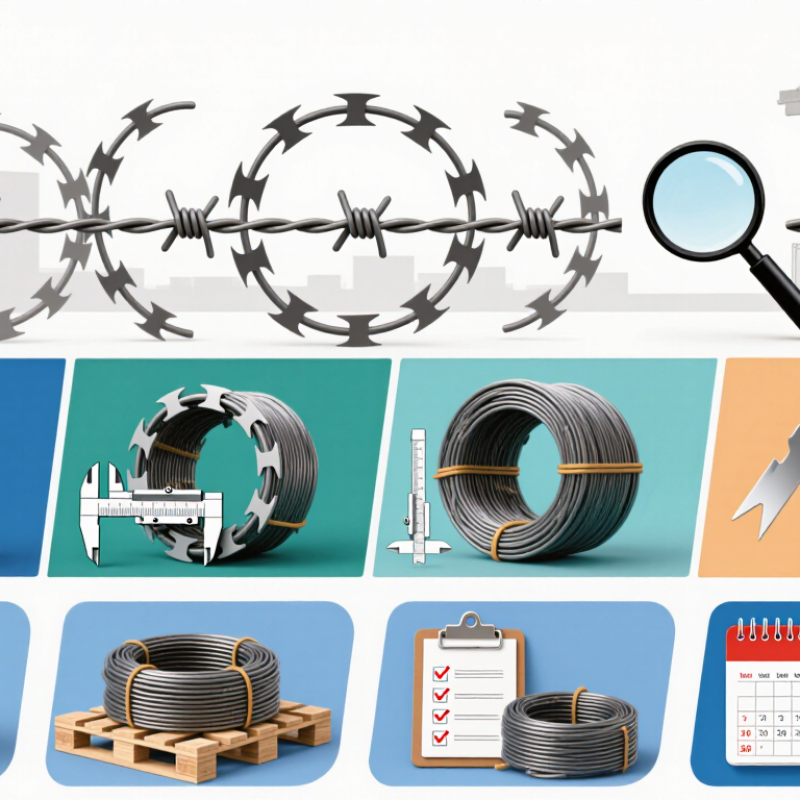
7 Security Barbed Wire Buying Tips for Global Buyers

Define Security Needs and Site Conditions

Before comparing wire specifications, define what the perimeter must protect and from which risks. A storage yard with occasional after-hours access needs different coverage from a continuously staffed utility site. Note the assets, likely approach routes, and existing barriers. Be specific. “Improve security” is not a useful requirement.

Walk the boundary in daylight and after dark. Check slopes, drainage channels, loose soil, and places where vehicles or people regularly pass. A fence that looks sound on a plan may leave a gap beside a loading gate. Measure the run, record gate locations, and photograph uneven sections. Small details matter. Also consider nearby homes, public paths, and routine maintenance access; wire placement should not create avoidable hazards for workers or passersby.

Site conditions affect material choice and upkeep. Coastal air can speed corrosion, while persistent moisture may expose weak coatings sooner than expected. Ask suppliers for clear specifications on coating, wire diameter, and installation requirements, then compare them with the local environment. If the ground is rocky or the fence line is irregular, get an installer to assess anchoring before ordering. I have seen plans revised after a simple site walk. That is inconvenient, but cheaper than discovering the mismatch after delivery.

7 Security Barbed Wire Buying Tips: Define Security Needs and Site Conditions

Wind Exposure and Fence-Line Planning

Wind exposure can affect the fence structure supporting security wire. The bars show dynamic pressure calculated as ½ρv², using an air density of 1.225 kg/m³. These are reference calculations, not site-specific design loads; assess local wind conditions and building-code requirements before selecting fence posts and supports.

Compare Barbed Wire Designs, Materials, and Coatings

Compare the wire design before comparing prices. Double-strand, twisted wire holds barbs firmly and suits many perimeter installations; single-strand designs can be lighter, but need careful tensioning. Check barb spacing, wire diameter, and coil dimensions against the fence structure. A sample tells you more than a catalogue image: inspect whether the barbs stay aligned when the wire is flexed. Small detail, big difference.

Material and coating determine how the wire handles weather and handling. Low-carbon steel is commonly used; higher-tensile wire can offer greater strength at a smaller diameter, but installation needs compatible posts and fittings. The World Steel Association’s World Steel in Figures 2025 reports 1,882.6 million tonnes of crude steel production in 2024. That signals broad steel supply, not consistent wire quality. Ask for tensile-strength and coating-thickness test records. Hot-dip zinc coatings are a familiar choice, while zinc-aluminium coatings may suit some exposure conditions; confirm performance data for the actual environment. Coastal air is unforgiving. I would not choose by coating name alone. Salt spray tests can help compare samples, but they do not perfectly predict years outdoors. Check coating coverage at cut ends and twists, where thin spots may be easy to miss.

Verify Product Standards and Export Requirements

Treat the product standard as a written purchase requirement, not a line on a quotation. For steel barbed wire, ASTM A121 covers metallic-coated carbon steel products; EN 10223-1 is another relevant specification. Confirm which version and test criteria the destination market accepts. Ask for coating type, wire diameter, barb spacing, tensile test results, and a traceable mill certificate. A certificate alone is not proof that each shipment meets the agreed specification.

Check export and import paperwork before production. Confirm the HS classification with a qualified customs professional, then verify destination rules for labeling, packaging, certificates of origin, and test documentation. Requirements can differ by country and product configuration.

That assumption is tempting. It is also risky.

The ISO Survey 2022 reported 1,265,216 ISO 9001 certificates across 187 countries and economies; this measures management-system certification, not barbed-wire product conformity. Ask what the certificate actually covers. Keep approved samples and inspection records with the order file, and resolve mismatches before loading. A missing test value can delay clearance. A rushed spreadsheet can misstate a requirement. Check it twice.

Assess Supplier Reliability and Product Quality

A dependable barbed-wire supplier should provide more than a polished catalogue. Request recent test reports that identify the wire grade, core-wire diameter, barb spacing, coil dimensions, and coating thickness. Ask whether results apply to the specific production lot, not just a similar sample. Check the details. The ISO Survey 2022 recorded 1,265,216 valid ISO 9001 certificates worldwide. This shows how widely quality-management systems are used, but certification alone does not verify a particular wire shipment. I would treat a neat certificate as a starting point, not a verdict.

Compare the report’s measurements with a physically inspected sample. Check for consistent barb spacing, secure twists, even coating, and sharp edges without loose metal fragments. Request batch identification and traceability records, then confirm that the supplier can link them to the delivered coils. Paper is not proof. A factory audit or independent inspection can help confirm that documented procedures match production. Ask for references from buyers with similar order volumes and shipping needs. A small sample order may reveal packing weaknesses that documents miss. It is not foolproof. Still, clear answers about rejected batches, corrective actions, and replacement terms often reveal more than a low quotation. Cite the report by name and year in purchasing records.

7 Security Barbed Wire Buying Tips for Global Buyers - Assess Supplier Reliability and Product Quality

Buying tip What to assess Practical verification Buyer action
1. Verify supplier capability Production capacity, quality-control procedures, export experience, and consistency between samples and bulk orders. Request a facility audit or live production review, process-flow details, inspection records, and references for comparable export orders. Confirm who manufactures the product and who is responsible for inspection, packing, and shipment.
2. Specify wire construction Number of line wires, wire diameter, barb-wire diameter, barb spacing, and barb-point configuration. Ask for a dimensioned drawing and sample measurements. Barbed-wire designs vary, so compare against the intended fence system rather than a generic description. Put all dimensions and permitted tolerances in the purchase specification.
3. Check base-metal and coating details Steel-wire grade, coating type, coating mass or thickness, and intended exposure conditions. Request material and coating test reports. Specify the required coating level and test method; do not rely on terms such as “heavy galvanized” without a measurable requirement. Match the coating specification to the environment, such as inland, humid, or coastal exposure.
4. Review standards and traceability Applicable product standards, batch identification, inspection records, and supporting certificates. Where appropriate, ask whether the product can be supplied to ASTM A121 or the relevant local equivalent, and request batch-linked documentation. State the required standard and documentation in the contract; verify that certificates correspond to the shipped batch.
5. Inspect workmanship and sample quality Uniform barb spacing, secure barb attachment, consistent twist, intact coating, and absence of sharp damaged ends or excessive deformation. Approve a representative pre-production sample and define a visual and dimensional inspection plan for the shipment. Record acceptance criteria and corrective-action requirements before production begins.
6. Confirm roll length and packing Specified roll length, coil weight, tying method, moisture protection, labeling, and handling safety. Ask for packing photographs and verify the net length or weight method. Ensure coils are secured and protected against corrosion and transport damage. Check that package dimensions and weights suit container loading and destination handling equipment.
7. Agree inspection, delivery, and compliance terms Pre-shipment inspection, order quantity, lead time, shipping terms, import requirements, and safe-use obligations. Set inspection timing and sampling criteria in writing; confirm destination-country import rules, labeling needs, and required shipping documents. Use suitable protective equipment during handling and installation, and ensure the product is used in accordance with local law.

Note: Product dimensions, coating requirements, applicable standards, and inspection criteria should be agreed in writing for each order and destination market.

Compare Total Costs, Shipping, and After-Sales Support

For security barbed wire, the quoted price is only one part of the purchase. Compare the delivered cost per usable metre, including coating, coil dimensions, export packing, freight, insurance, and destination charges. Ask suppliers to state wire gauge, barb spacing, coil diameter, and coating specifications on the same quotation basis. Small details matter.

Shipping can change the economics quickly. UNCTAD’s Review of Maritime Transport 2024 reported that spot container rates from Shanghai reached about $4,816 per 40-foot container to Europe in June 2024, roughly 3.5 times their early-December 2023 level. This is a specific route and period, not a universal shipping benchmark. Still, it shows why buyers should request current freight quotes, confirm container loading plans, and check whether coils need special handling. A low unit price may lose its appeal after a rate change.

After-sales support deserves a line in the contract. Confirm how coating defects, transit damage, or quantity shortages are documented and resolved, and ask for inspection records before dispatch. Clarify response times, replacement terms, and availability of matching specifications for future orders. These details can feel tedious. Yet a vague warranty is hard to use when a shipment arrives with damaged packaging or inconsistent coil sizes. Allow time for port delays, too; delivery estimates are not guarantees.